
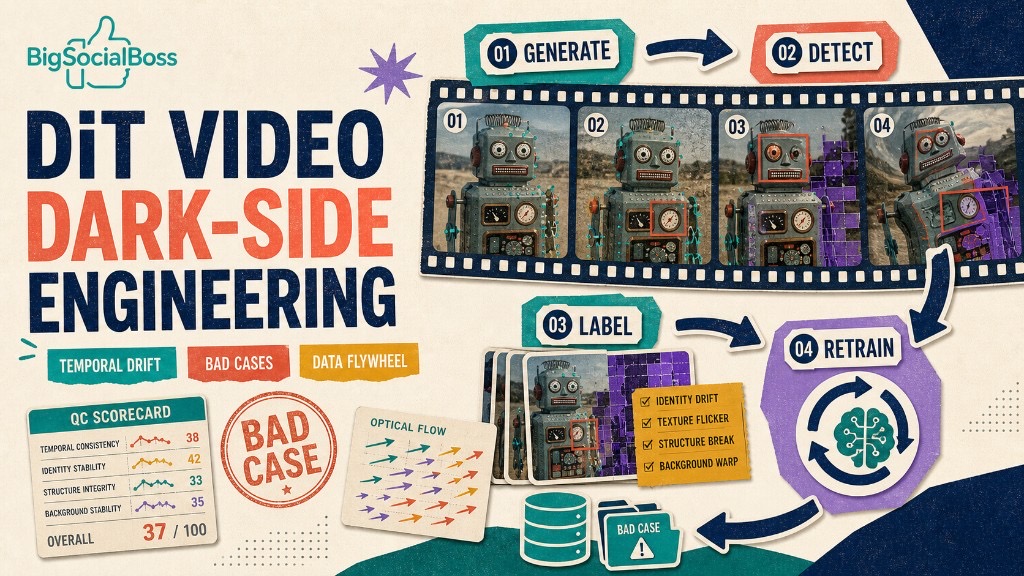
BigSocialBoss builds custom video-flaw data packs for generative video models: Bad Case cleanup, failure-mode design, frame-level labels, eval sets, and ongoing batch production. Official: data-services
✈️ Telegram: Kxg245 WeChat: BigSocialBoss123 Ask about video-flaw packs → Open Telegram
When generated video moves from 5 seconds to 30 or 60, the model’s failures are no longer just single-frame quality. The question is whether people, objects, motion, and space stay consistent along the timeline. What is scarce is not more “good video.” It is high-value Bad Cases that have been defined, located, and labeled.
1. Frames look more real. The timeline fails more easily.
Over the past two years, mainstream video models have improved texture, text understanding, and camera language. Architectures such as Diffusion Transformer (DiT) can model a larger space-time range. Once the clip gets longer, the amount of information that must stay true grows fast: identity, clothing, props, background structure, motion paths, lighting, and cause-and-effect between shots all have to hold.
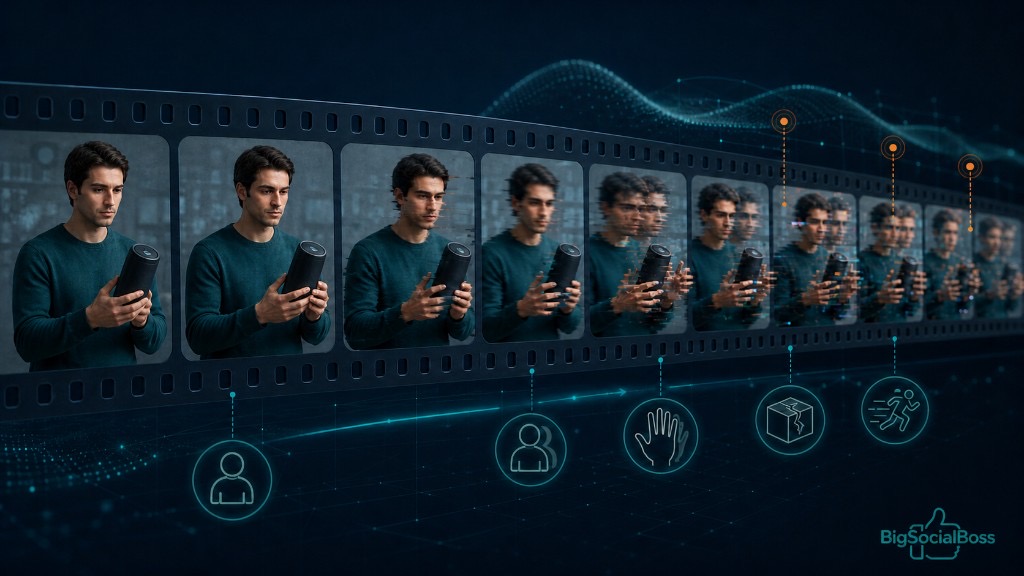
So the difficulty of long video is not “generate more frames.” The longer the sequence, the more the early visual conditions drift later, and small errors pile up along time. Causes differ by model and pipeline, but the visible failures tend to fall into a few types:
- Object and identity drift: A face, haircut, or outfit changes for no reason. Product structure, logos, or pack copy no longer match from shot to shot.
- Broken motion and interaction: A grip suddenly changes, action jumps, objects clip, float, or collide with no response.
- Space and lighting mismatch: Background layout changes, occlusion is wrong, shadows snap direction, or objects cannot be mapped after a cut.
- Story and meaning drift: Characters, props, or scenes change with no plot reason, so shots no longer connect.
The shift is this: video quality is moving from “does this frame look good” to “is the whole timeline believable.”
2. A negative sample is not a “bad video.” It is an explainable failure mode.
In older labeling work, negatives often meant blur, shake, or bad exposure. For generative video, sorting clips into “good” and “bad” is not enough. Training, eval, and QC need: where it happened, how long it lasted, which object it hit, which failure mode it belongs to, and how severe it is.
In other words, a high-value negative is not a folder of failed clips. It is evidence you can search, count, review, and reuse. It should have three properties:
- Recognizable: The defect has a reasonably clear boundary, with positive examples, counterexamples, and edge cases.
- Locatable: The issue can sit on a video, a shot, a time span, a frame, an object, or a region of the picture.
- Reusable: Labels, fields, and file formats can enter later training, eval, regression tests, or human QC.
3. Automatic detection can speed the work. It cannot replace the label list.
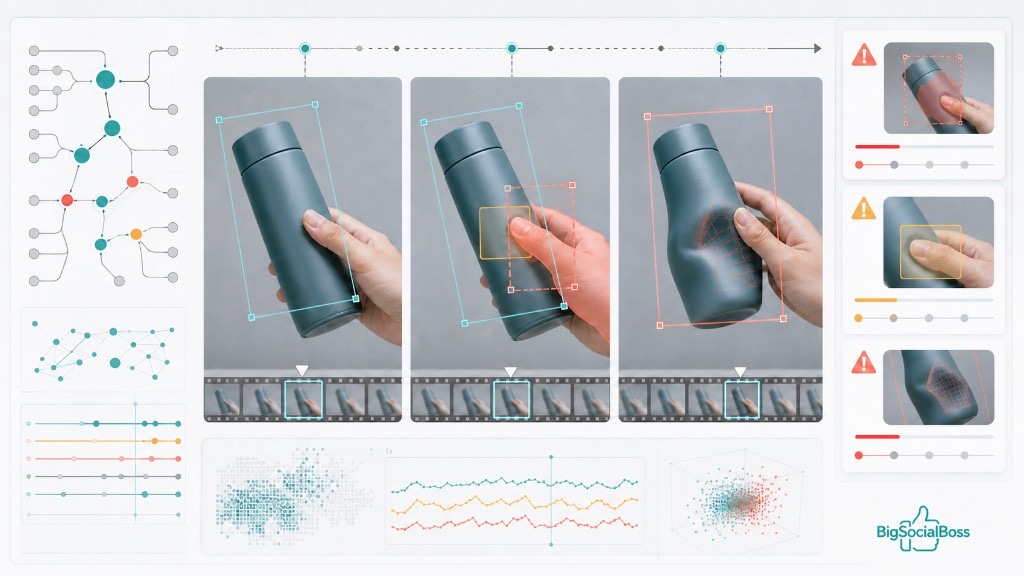
Video-flaw data work usually mixes several automatic signals to shortlist candidates from a large generate pool. For example:
- Optical flow and motion consistency: Helps find odd displacement, local motion snaps, and broken edges. Fast camera moves, occlusion, and transitions can also false-alarm.
- Cross-frame visual features: Helps watch whether people, objects, and scenes stay stable. Similarity thresholds must be calibrated to the scene.
- Keypoints, masks, and tracking: Helps locate limb errors, clipping, and object drift. Semi-automatic output still needs human review.
- Domain rules and multimodal judgment: Product structure, brand rules, physics, and story logic often need domain knowledge. One model score cannot cover them.
So automation is better at “find candidates” and “check format.” The label system, edge cases, and final call still have to be designed around the business. The same visual error can mean a light miss in a short drama, a hard fail for a digital human, or a scrap clip in an e-commerce ad.
4. From Bad Case to a data asset, you need a closed loop
A lasting flaw-data process is not a one-off labeling job. It cycles with model versions:
- Collect: Model outputs, human review notes, live complaints, and targeted generates.
- Screen: Rules, model signals, and a first human pass. Deduplicate and keep representative Bad Case candidates.
- Define: A type list, label notes, severity, exclusions, and edge cases.
- Label: Video-level, span-level, frame-level, object-level, or pixel-level — whichever the use needs.
- QC: A gold set, automatic format checks, spot review, or two-person review for consistency.
- Feed back: Use the data for eval, a QC model, or the next train. Then mine new failures from the new version.
The real flywheel is not “more samples.” It is making each round closer to how the model actually fails in the business.
5. Why a vertical scene beats generic data
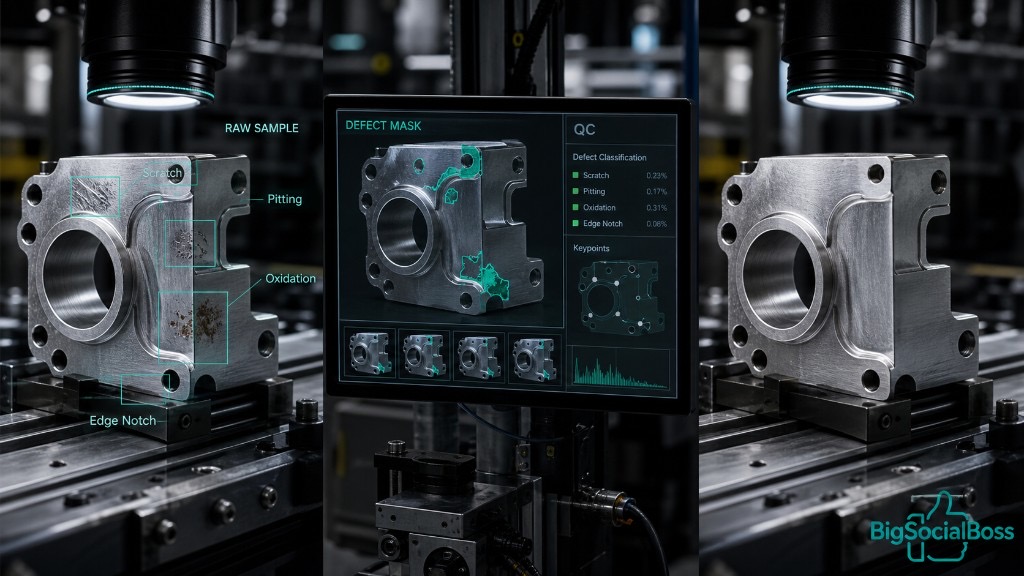
Generic eval can answer overall ability. Companies care whether their content is usable. Short-drama teams care about character and prop continuity. Digital-human teams care about lips, expression, and gesture lock. E-commerce teams care whether product structure, pack copy, logos, and materials stay true.
The labels differ, and so do the pass bars. The same “hand error” in a wide, short shot may be a light miss. In a product demo or a close-up, it can kill the clip. So a vertical data project does not start with a labeling tool. It starts with how failure modes are defined, how fine the labels should be, and which samples actually help this business.
6. What a usable flaw pack usually includes
Delivery can change with train and eval goals. A complete pack usually includes:
- Data files: Source video, processed clips, evidence frames, and stable file IDs.
- Labels: JSON, JSONL, CSV, or a schema you specify — types, time spans, object positions, and short notes.
- Labeling guide: Type list, field notes, good and bad examples, edge cases, and how disputes are handled.
- Quality record: Label mix, spot-check results, rework notes, version info, and known limits.
Whether data is “trainable” depends on whether it plugs into your model, eval scripts, and pipeline. Before scale production, a small representative pilot to freeze format is usually more important than chasing volume.
Close
Video generation is moving from demo to production you can repeat. In that shift, a Bad Case should not only be deleted. It should become an asset for understanding the model’s edge, setting a quality bar, and driving the next train.
When a team can keep finding failures, describe them accurately, and turn them into reusable data, model work actually closes the loop. For DiT-era video, flaw-data engineering is not a side labeling job. It is the infrastructure that connects generate, eval, QC, and train.
Talk to us: BigSocialBoss works with companies, AI teams, and model vendors on video Bad Case cleanup, failure-mode design, frame-level labels, eval sets, and ongoing batch production. Service page: data-services
To discuss a scene or request a sample, leave a note on the WeChat account, or submit an inquiry on the site: technical counterpart + company / team + use case.