
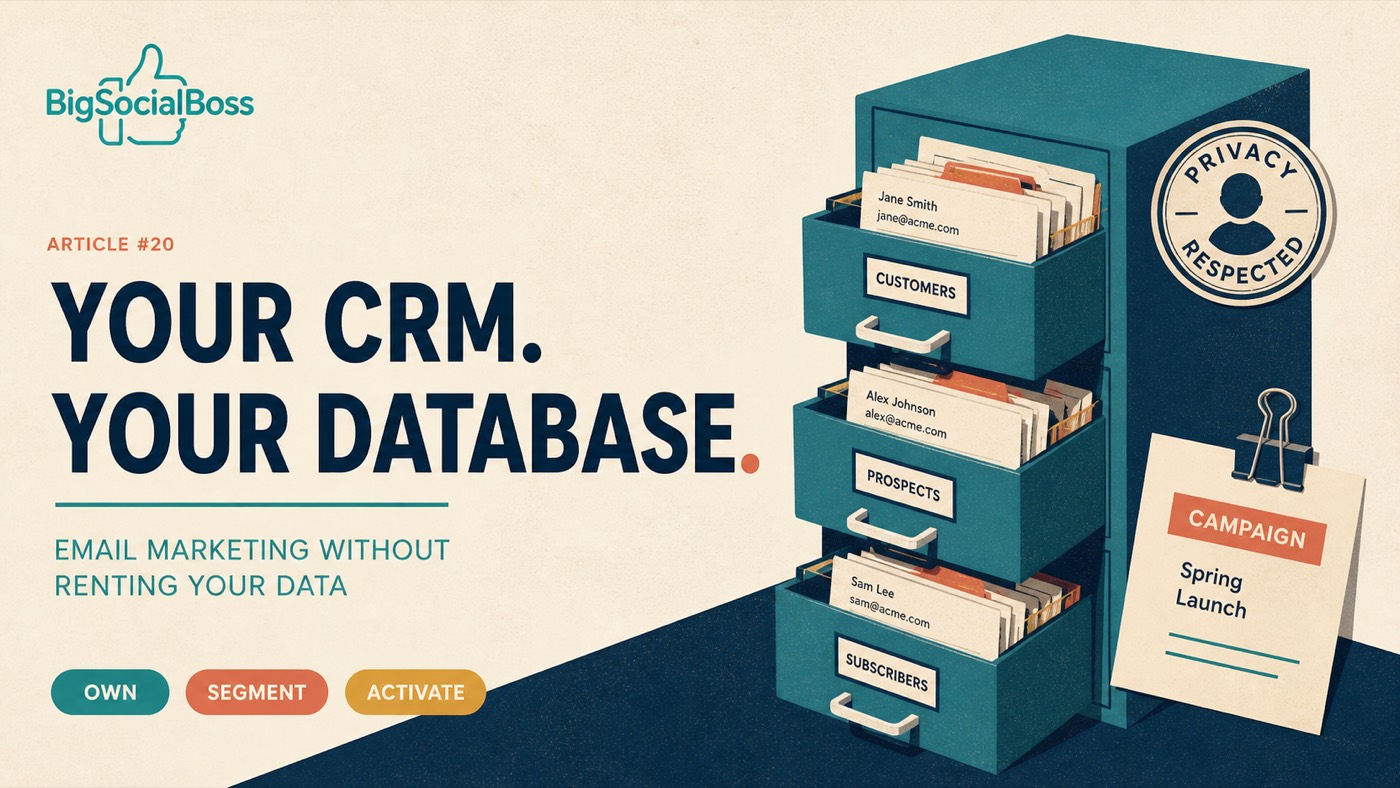
Your contact database is one of your company's most valuable assets. It contains the names, email addresses, preferences, behaviors, and purchase histories of every person who has ever engaged with your brand. It is the foundation of your marketing, the fuel for your sales pipeline, and the record of your customer relationships.
So why do most businesses hand it over to a third-party cloud provider?
The answer is habit. For years, the default choice was to sign up for Mailchimp, HubSpot, or Salesforce and upload your data to their servers. It was easy, it was fast, and everyone else was doing it. But the landscape has shifted. Data privacy regulations are tightening. Security breaches are headline news. And businesses are waking up to the risks of vendor lock-in.
This article explores why a private database and CRM matter for email marketing, what risks you face when your data lives on someone else's servers, and how platforms like BigSocialBoss give you complete data ownership without sacrificing functionality.
✈️ Telegram: Kxg245 WeChat: BigSocialBoss123 Claim a free trial of the TK viral video extension → Open Telegram
The Data Ownership Problem
When you use a cloud ESP or CRM, you are renting space on someone else's infrastructure. Your contact lists, campaign data, analytics, and customer interactions all live on servers you do not control, managed by a company whose priorities may not align with yours.
This creates several categories of risk:
1. Compliance and Regulatory Risk
GDPR, CCPA, HIPAA, SOC 2, and an alphabet soup of other regulations require businesses to know where their data is stored, who has access to it, and how it is protected. When your data lives on a cloud provider's servers, answering these questions becomes complicated.
- Auditors ask: Where is the data physically located? Who can access it? Is it encrypted at rest and in transit? What happens if the provider is acquired or goes out of business?
With a self-hosted platform like BigSocialBoss, these questions have simple answers: Your data is on your server. You control access. You control encryption. You control everything.
2. Vendor Lock-In
Once your customer data is in a cloud CRM or ESP, extracting it is never as easy as uploading it was. Export tools are limited. Data formats are proprietary. Relationships between records get broken. And if the provider changes their pricing, their terms, or their API, you have limited leverage.
The result? You stay with a platform that no longer serves your needs because the cost of leaving is too high.
BigSocialBoss stores all data in standard formats on your own server. If you ever want to migrate, your data is already in your possession—no extraction required.
3. Security and Data Breaches
Cloud providers are high-value targets. A breach at a major ESP or CRM can expose millions of customer records—including yours. Even if the breach is not your fault, your customers will hold you responsible. Your brand suffers. Your trust erodes.
When your data is self-hosted, your attack surface is smaller. You are not part of a massive target. And you control every security measure: firewalls, encryption, access controls, and backup policies.
4. Data Mining and Secondary Use
Most cloud platforms' terms of service include clauses that allow them to use your data in aggregated or anonymized form. Some go further. And when a provider is acquired, your data becomes part of the deal—transferred to a company you never chose to work with.
With BigSocialBoss, your data is yours. Period. No mining. No secondary use. No surprise acquisitions affecting your privacy.
What "Private Database and CRM" Actually Means
The phrase gets used loosely. Let us be specific about what a truly private email marketing platform with CRM should include:
- Self-hosted deployment: The entire platform—database, application, mail server—runs on infrastructure you control. This can be a VPS, dedicated server, or private cloud.
- Database ownership: Your contact data, campaign history, analytics, and CRM records are stored in a database on your server. You have full administrative access.
- No third-party data sharing: Your data is never transmitted to the vendor's servers, shared with partners, or used for training AI models.
- Full backup and export control: You control backup schedules, retention policies, and data export. No vendor-imposed limits.
- Network isolation: Your database is not accessible from the public internet. Only your application and authorized administrators can connect.
Why CRM and Email Marketing Should Share One Database
Most B2B teams use separate tools for CRM and email marketing. HubSpot or Salesforce for CRM. Mailchimp or Brevo for email. The two systems are connected by APIs that sync data back and forth.
This architecture creates constant problems:
- Sync delays: A contact updates their information in the CRM, but the email platform still has old data for hours or days.
- Data conflicts: The same contact exists in two systems with different information. Which one is correct?
- Broken integrations: API changes, rate limits, and authentication failures constantly disrupt the connection.
- Limited context: Your email platform does not know a contact's deal stage, last sales call, or support ticket history. Your CRM does not know which emails they opened or which links they clicked.
When CRM and email marketing share one database—as they do in BigSocialBoss—these problems disappear. Every piece of customer data is in one place, accessible to both systems in real time.
What BigSocialBoss Provides
BigSocialBoss is designed as a single, unified platform where your email marketing, CRM, contact database, and analytics all live in one system on your own infrastructure.
- Docker-based self-hosting: Deploy on any VPS or server in under 5 minutes. Your data never leaves your control.
- Integrated CRM: Track contacts, deals, interactions, and lifecycle stages. Every email open, click, and reply is logged to the contact record automatically.
- Private database: All data stored in a secure database on your server. Full admin access. Standard format. No proprietary lock-in.
- Email marketing suite: Campaign builder, automation workflows, templates, list segmentation, and A/B testing—all connected to the same CRM data.
- Advanced segmentation: Segment contacts by CRM data (deal stage, lead score, last interaction) combined with email behavior (opens, clicks, inactivity).
- Role-based access control: Define who can see what. Sales sees CRM. Marketing sees campaigns. Management sees reports. No overlap, no leaks.
- Automated backups: Schedule database backups to your own storage. Control retention. Restore anytime.
✈️ Telegram: Kxg245 WeChat: BigSocialBoss123 Claim a free trial of the TK viral video extension → Open Telegram
Who Needs a Private Email Marketing CRM?
Not every business needs this level of control. But for these profiles, it is essential:
- Regulated industries: Healthcare, finance, legal, and government contractors face strict data residency and privacy requirements. Self-hosting simplifies compliance.
- Agencies managing client data: When your clients trust you with their customer lists, storing them on a third-party platform creates liability. Self-hosting gives you—and your clients—peace of mind.
- Enterprises with data governance policies: Many large companies require customer data to remain on company-managed infrastructure. Cloud ESPs violate these policies by default.
- Privacy-focused businesses: If your brand promise includes respect for customer privacy, keeping data on your own servers is a powerful proof point.
- Teams burned by vendor changes: If you have ever had a platform change pricing, remove features, or get acquired in a way that hurt your business, self-hosting eliminates that risk permanently.
Deployment: Easier Than You Think
The most common objection to self-hosting is complexity. Teams worry they will need a DevOps engineer, a security consultant, and a database administrator.
That was true ten years ago. It is not true anymore.
BigSocialBoss deploys via Docker. One command. Five minutes. The entire platform—mail server, web application, database, and security layer—is installed, configured, and ready to use.
You do not need to configure Postfix, generate DKIM keys, set up Nginx, or create database users. BigSocialBoss handles all of it. You provide a VPS and a domain. The platform does the rest.
After deployment, management is equally simple. Updates are one command. Backups are automated. Monitoring is built-in. You get the control of self-hosting with the simplicity of SaaS.
The Cost Advantage
Let us compare the real cost of owning your data versus renting it:
- Cloud ESP + CRM (HubSpot + Mailchimp): HubSpot CRM $50/mo + Mailchimp $200/mo (20K contacts) = $3,000/year. Add email verification ($50/mo) = $3,600/year. Add dedicated IP ($50/mo) = $4,200/year. Data lives on their servers. Subject to their terms.
- BigSocialBoss (self-hosted): Platform license $199 one-time. VPS hosting $10/mo x 12 = $120/year. Total first-year cost: $319. Total second-year cost: $120. Data lives on your server. Subject to your terms.
Over three years, the cloud stack costs $12,600+. BigSocialBoss costs $559. That is a 95% reduction in total cost of ownership—with more control, better privacy, and no vendor lock-in.
Final Thoughts
The era of blindly uploading your customer data to third-party clouds is ending. Regulations are tightening. Breaches are common. And businesses are realizing that data ownership is not just a security issue—it is a competitive advantage.
An email marketing platform with a private database and CRM gives you something no cloud provider can match: complete control. Control over where your data lives. Who can access it. How it is used. And what happens to it.
BigSocialBoss makes this accessible. Docker deployment, built-in CRM, dedicated IPs, and lifetime pricing—all on your own infrastructure. The setup takes 5 minutes. The benefits last forever.
If your customer data matters to you—and it should—it is time to bring it home.
✈️ Telegram: Kxg245 WeChat: BigSocialBoss123 Claim a free trial of the TK viral video extension → Open Telegram