
✈️ Telegram: Kxg245 WeChat: BigSocialBoss123 Claim a free trial of the TK viral video extension → Open Telegram
Introduction: The True Cost of Email Marketing Nobody Talks About
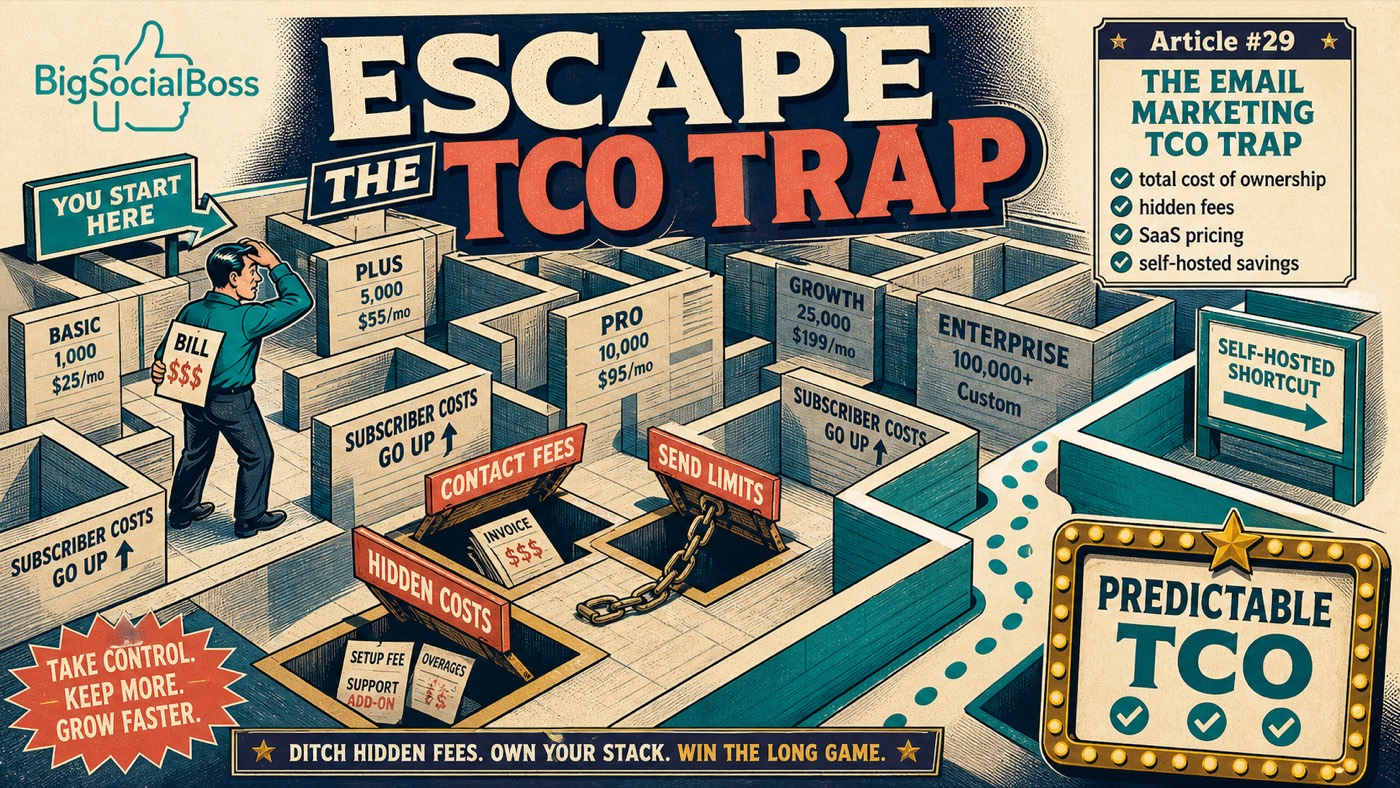
When businesses evaluate email marketing platforms, they usually see surface-level monthly fees first -- subscription platforms often advertise low entry prices. Those seemingly "cheap" starting points are among the most sophisticated pricing strategies in the ESP industry. Yet true Total Cost of Ownership (TCO) is often ten times -- or more -- the initial sticker price.
According to the Litmus and DemandSage 2026 joint research, email marketing delivers an average ROI of $36-42 for every $1 invested, making it the highest-return digital marketing channel. The same report also shows that fewer than 13% of businesses believe they measure email marketing ROI well. Most teams never fully understand their real spend -- or how much is consumed by hidden costs.
This article analyzes hidden traps in mainstream ESP pricing, integration costs from tool fragmentation, strategic risks of migration and vendor lock-in, and how BigSocialBoss restructures email marketing economics through one-time perpetual licenses.
I. Hidden Traps in Mainstream ESP Pricing Models
1.1 Per-Contact Pricing: Exponential Cost Growth
Mainstream subscription ESPs widely use per-contact or per-send pricing. On paper, you pay for what you use. In practice, costs grow non-linearly -- often exponentially -- as your business scales.
Many platforms attract users with low entry tiers, then charge sharply more as lists reach tens or hundreds of thousands of contacts. That is often only the base platform fee, before dedicated IP add-ons, advanced automation, extra seats, and CRM integrations.
Some pricing models effectively tax growth: the better your business performs, the higher your bill climbs.
The hidden issue: list growth does not always mean linear revenue from email. Large inactive segments may still be billed at full rates because platforms do not distinguish active vs. dormant contacts.
Industry surveys show growing SMEs often spend far more on email-related tooling each month than headline "starter" prices suggest -- before AI content tools, integration platforms, and separate CRM subscriptions.
1.2 Feature Tier Pricing: The Feature Unlock Game
Beyond contact counts, feature tiers lock capabilities such as A/B testing, multi-step automation, dynamic content, advanced segmentation, and send-time optimization behind more expensive plans.
Teams often underestimate what they need, upgrade later, and end up paying multiples of their original budget. Capabilities such as dedicated IP sending may only appear on top tiers, forcing smaller teams to accept shared IP risk or pay for plans they do not otherwise need.
Reports show a meaningful share of marketing budgets flows to email. When email is a primary revenue channel, that share rises further -- and unpredictable ESP fee growth squeezes other campaigns.
II. Integration Costs of Tool Fragmentation
2.1 Email + CRM + Analytics: The Triple Subscription Burden
Modern email marketing is not just "send email." A full stack often includes ESP, CRM, analytics/attribution, landing pages, and AI content tools -- each with its own subscription and integration work.
In subscription ecosystems, capabilities are fragmented: email, CRM depth, and sending infrastructure often live in different products. B2B teams may need extra CRM tools; sending may still rely on shared IP pools; ecommerce automation and B2B outbound needs rarely fit one stack cleanly.
The triple-subscription pattern creates direct fees plus hidden costs: sync issues, manual reporting, and training across multiple UIs. For SMEs, hidden costs often exceed subscription fees themselves.
BigSocialBoss difference: CRM, email marketing, and campaign analytics are built into one product -- contacts, follow-ups, templates, formal sends, and opens/clicks/unsubscribe stats without separate accounts or bills.
2.2 Hidden Costs of Automated Workflows
By 2026, automation is mandatory, not optional. Industry data shows automated email drives a disproportionate share of revenue; welcome and reminder flows often outperform bulk sends on opens and clicks.
Building workflows still requires design time and cross-system engineering. When ESP, CRM, and business systems are separate, a full trigger → email → follow-up → attribution chain can take weeks to implement and test.
Platforms differ widely in automation depth and learning curve -- another source of uncertainty when choosing a long-term stack.
BigSocialBoss difference: Built-in follow-up flows and live send monitoring; templates support paste-link HTML import and a commerce email assistant -- less hopping between tools for each campaign.
✈️ Telegram: Kxg245 WeChat: BigSocialBoss123 Claim a free trial of the TK viral video extension → Open Telegram
III. Data Migration and Vendor Lock-in Strategic Risks
Vendor lock-in is another hidden cost of subscription ESPs. After years of data, templates, workflows, and team training on one platform, migration becomes expensive.
Migration is not just CSV export/import. Templates must be rebuilt; workflows recreated; teams retrained; historical sends and reports may not transfer fully -- a serious loss for data-driven marketing.
Stricter privacy rules (GDPR, US state laws) add compliance risk when moving personal data between vendors.
When scale demands dedicated IPs and controlled sending infrastructure, many teams discover they are locked into plans that cannot provide economical dedicated lanes -- forcing expensive upgrades or full migration.
BigSocialBoss difference: Standalone Docker packs with licensed install keep site and data on your VPS; sending uses dedicated VPS lanes and your domains, not shared bulk pools -- reducing lock-in at the architecture level.
IV. BigSocialBoss: One-Time Perpetual License Cost Revolution
Against rising hidden costs in subscription models, BigSocialBoss offers one-time perpetual licenses that restructure platform economics: pay once for the software, use it ongoing -- no monthly license fee, no per-contact billing, no paywalls for core upgrades.
4.1 TCO Restructured: Transparent Tiers from $39 to $299
BigSocialBoss pricing is straightforward:
- Experience pack: $39 one-time perpetual license, ~3,000 emails/day -- validate self-hosted deploy and sending
- Main tiers: $59 to $299 one-time perpetual license, 5,000–120,000 emails/day by daily volume and lane/domain slots
- Billing logic: tied to daily send volume, not total contact count -- large databases, pay only for the send tier you need
Compared with "more contacts = higher monthly bills," this gives B2B teams with big lists and steady sends predictable long-term TCO.
Per BigSocialBoss FAQ, standalone tiers are perpetual licenses (one-time payment, no monthly software fee). The $39 experience tier runs full install and sending on your VPS; steady-volume teams can buy the right tier once instead of stacking years of subscription.
Dedicated sending: Cloud plans include dedicated VPS mail lanes and independent IP capability -- deliverability and reputation ride on your infrastructure, not a shared pool with strangers.
4.2 CRM + Email + Analytics Integration: Reducing Tool Redundancy
Unlike multi-subscription stacks, BigSocialBoss unifies CRM, email marketing, and campaign analytics:
- Templates & content: library, paste-link HTML import, commerce email assistant
- CRM: contact database, industry tags, follow-up workflows
- Audience & sending: CSV/industry imports, formal sends, live progress monitoring
- Campaign stats: delivery, opens, clicks, subscribe/unsubscribe, bounces, recipient lists, round history
One platform means fewer SaaS bills, less sync work, and one UI for your team to learn.
4.3 Data Sovereignty: Priceless Risk Hedging
Traditional ESP SaaS stores contacts, templates, reports, and analytics on vendor servers. Export exists, but full migration remains costly.
BigSocialBoss self-hosted Docker keeps site and database on your VPS -- templates and reports belong to you, audit paths are clearer, and vendor lock-in drops sharply.
Per standalone deployment docs: your data, your IPs -- site and DB on your server; sending on your relay lanes and domains, not shared bulk pools. For GDPR and similar regimes, that strategic advantage is hard to price in monthly fee deltas.
Low ops barrier: Licensed install with pre-built Docker images -- no source build or deep DevOps; workbench-oriented setup gets you into the email UI in about five minutes (see official standalone guides).
V. Cost Decision Framework: How to Choose the Right Model
Use TCO, not headline monthly fees, when selecting a platform:
- Measure real send volume and list activity, not just contact totals.
- Sum the full toolchain -- can email, CRM, analytics, and integrations close inside one product? BigSocialBoss reduces that stack.
- Assess migration and lock-in -- templates, workflows, history; does self-hosting match sovereignty needs?
- Evaluate sending infrastructure -- dedicated VPS lanes, independent IPs, and your domains vs. long-term shared pools.
- Confirm ROI tracking -- delivery, opens, clicks, and list detail for optimization.
For B2B teams with stable daily volume that value sovereignty and lower long-term TCO, BigSocialBoss perpetual licenses plus dedicated sending are a strong alternative: $39 experience to validate fit; $299 top perpetual tier still below years of stacked subscriptions.
Email remains among the highest-ROI digital channels -- but only when true costs are understood and controlled. Choose the right economic model so budget flows to content, segmentation, and strategy -- not unpredictable subscription bills.
BigSocialBoss focuses on enterprise email marketing and dedicated sending: perpetual standalone licenses, dedicated VPS lanes, integrated CRM and stats, English and Chinese UI, Beijing-time reporting. Start with standalone plans or free signup.
✈️ Telegram: Kxg245 WeChat: BigSocialBoss123 Claim a free trial of the TK viral video extension → Open Telegram