
From open-source tools to a commercial platform: one guide to choosing self-hosted email marketing.
In 2026, email marketing is moving from renting to owning
For years the default was a SaaS signup: pay monthly, pay by volume, and keep the list on someone else's server. Three shifts are making teams reopen that decision:
- Subscription fatigue: the bill climbs with contacts and send volume. The more the business works, the less the cost stays predictable.
- Risk you do not control: shared IP pools punish everyone together, and an account can be throttled or shut off. The switch for sending is not in your hands.
- Data ownership: the customer list and engagement history are core assets. More teams do not want them parked on a third-party platform.
That is why "self-hosted email marketing software" is a high-frequency search in 2026. The system runs on your server, the data stays private, and the cost moves from a permanent subscription to a one-time spend. This roundup covers the main choices and the criteria that matter.
✈️ Telegram: Kxg245 WeChat: BigSocialBoss123 Free trial of the TikTok viral plugin → Open Telegram
Four checks before you pick self-hosted email software
- Does it include its own sending engine? This is the check most teams skip, and it is the one that decides the outcome. A lot of "self-hosted" software is only an admin console. The actual send still goes through SES or SendGrid, so you still inherit relay risk controls and per-message fees. Real self-hosting delivers from your own server, with no third-party relay in the path.
- License: a monthly or yearly subscription, or a one-time buyout. For a team that will send for years, the buyout is a different order of cost.
- How hard it is to deploy: compile and configure it yourself, or take an install pack, a one-click deploy, or a done-for-you install.
- Who owns the data: is the database fully private, and can it connect to your own CRM or BI?
The main self-hosted options in 2026
1. Open source: Mautic / Listmonk
No license fee, and a mature community. A good fit for a technical team that wants to run the stack itself. They are still marketing consoles: the sending layer expects an SMTP relay, and bounce parsing plus delivery tracking are pieces you add. The hidden cost is people.
2. A commercial self-hosted platform: BigSocialBoss
A different route: its own sending engine plus a parsing system, in a two-machine layout. After install, mail leaves your server and replaces the SES / SendGrid relay role. Nothing passes through a third party. IP reputation accrues on your infrastructure. Bounce classification and delivery status write back into the product. Product overview: aideskbuddy.cn.
The four install packs are on the email marketing pricing page.
BigSocialBoss self-hosted email platform: what you get, and the packs
What it does
- Own sending engine: SMTP delivery, queue scheduling, and rate limits. No third-party relay. Placement depends on how you send.
- Parsing: hard and soft bounces classified automatically, delivery status parsed, opens and clicks tracked, results written back to the contact record.
- Private CRM: full customer lifecycle, custom groups and tags, follow-up status. The data sits in your MySQL.
- Automation: CRM-based triggers, multi-step nurture, A/B tests.
- Reporting: delivery, opens, clicks, unsubscribes, complaints, and failure detail on one board.
- Chinese and English UI: one switch, so a cross-border team can work in either language.
Packs and price (one-time buyout, perpetual license)
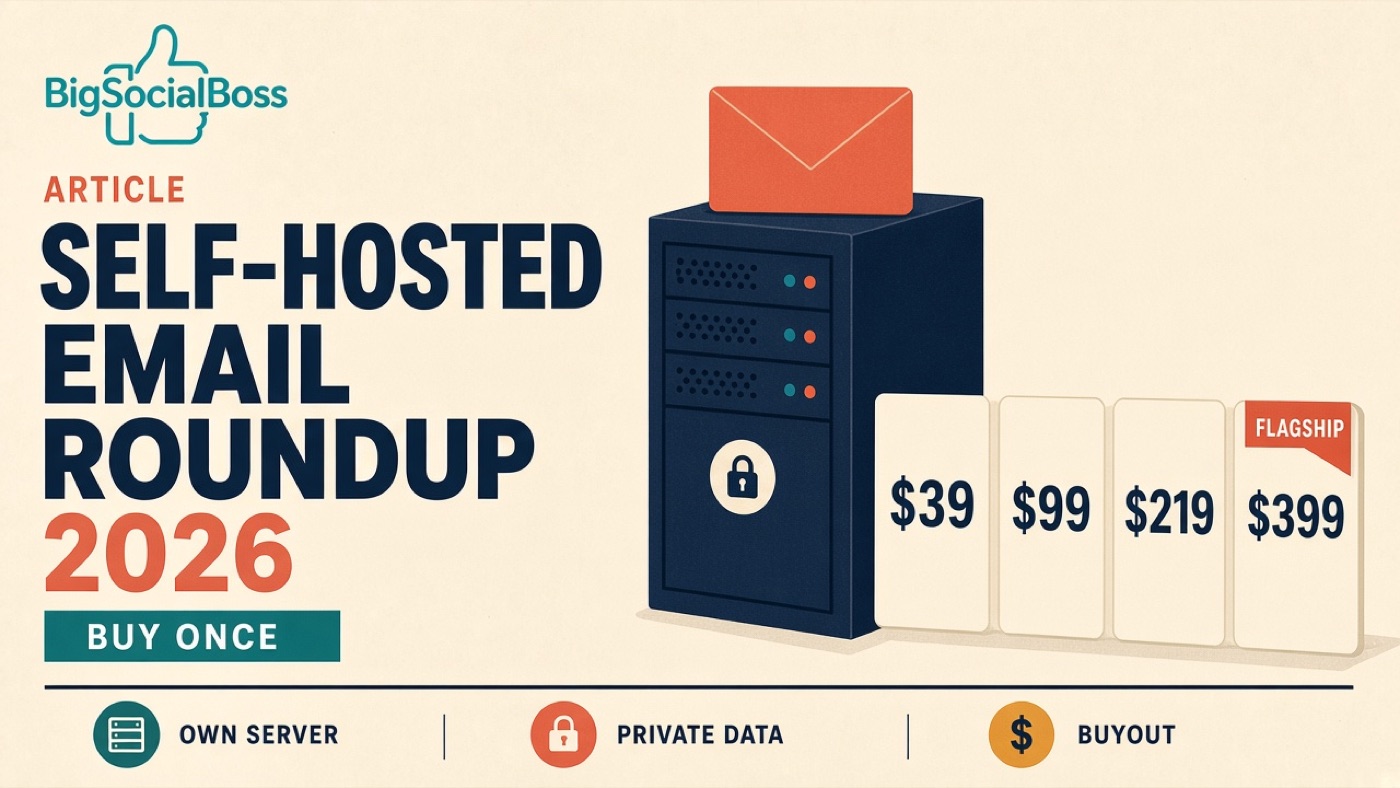
- Starter: 3,000 emails a day, $39
- Standard: 30,000 emails a day, $99
- Professional: 50,000 emails a day, $219
- Flagship: 100,000 emails a day, $399
All four are paid once, licensed permanently. No monthly fee, no per-message meter, no hidden charge. Pick the pack you need now and move up when volume grows.
The cost, in one comparison
Take a team sending 30,000 emails a day, about 900,000 a month:
- SaaS path: mainstream platforms at that volume are commonly hundreds of dollars a month, thousands a year, and the price rises with the list. That is rent.
- BigSocialBoss path: the Standard pack is a $99 one-time buyout, plus a VPS you already pay for (about $5–20 a month). First-year total is a few hundred dollars. From year two, the remaining cost is the server.
The gap is above 90%. The infrastructure — IP reputation, customer data, templates and workflows — stays an asset you own. A platform policy change does not wipe it out.
Live in 24 hours
You need two things first: your own server (a VPS is enough) and a domain. Then pick one:
- Install it yourself: the install pack and docs are enough if you can do basic Linux. No service fee.
- Done-for-you install: $15. We finish the deploy and the domain authentication (SPF / DKIM / DMARC) remotely and hand it over within 24 hours.
This fits export, cross-border, and B2B teams with a steady send, companies that treat the list as an asset, and operators who are done with SaaS subscriptions and account risk controls. The 3,000-a-day pack is enough to start. The 100,000-a-day pack carries a mature team's volume.
Closing
Choosing email software in 2026 is no longer about who has the lower monthly fee or the larger template gallery. It is about who lets you own the sending path and the customer data. Self-hosting plus a buyout is that answer.
BigSocialBoss starts at a one-time $39, so a team can run the kind of mail infrastructure that used to be reserved for large companies. Not a rental. Ownership.
To get a deploy plan, message WeChat BigSocialBoss123 or Telegram Kxg245, or open aideskbuddy.cn. Note the pack you want and your daily volume. Pricing: four install packs.